Learning Outcomes:
i. Define and differentiate between precision and accuracy in measurements.
ii. Identify examples of precise but inaccurate measurements and accurate but imprecise measurements.
iii. Explain the importance of achieving both precision and accuracy in scientific measurements.
iv. Understand the relationship between precision, accuracy, and error.
Introduction:
In the realm of science, precise and accurate measurements are the cornerstone of reliable and trustworthy results. Measurements serve as the foundation for scientific investigations, providing the data upon which theories are built and conclusions are drawn. However, not all measurements are created equal. Two key concepts that govern the quality of measurements are precision and accuracy. This lesson delves into the intricacies of precision and accuracy, elucidating their significance in scientific endeavors.
i. Precision:
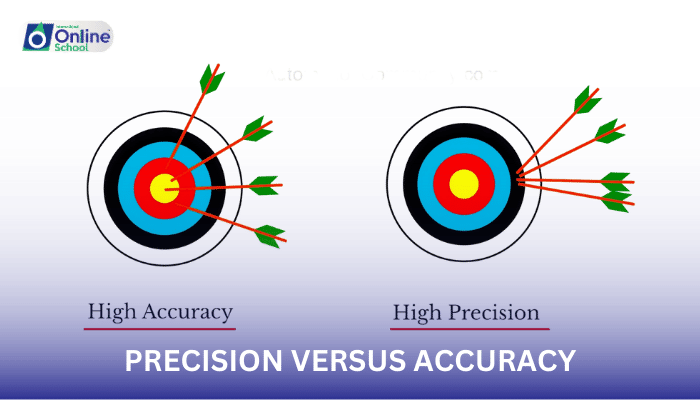
Precision refers to the closeness of repeated measurements to each other. It reflects the consistency or reproducibility of a measurement process. For instance, if you measure the length of an object multiple times with a ruler and obtain values of 10.2 cm, 10.1 cm, and 10.2 cm, these measurements are considered precise. They are tightly clustered together, indicating a consistent measurement procedure.
ii. Accuracy:
Accuracy refers to the closeness of a measured value to the true or accepted value. It reflects how close a measurement is to reality. To illustrate, if you measure the length of an object that is known to be 10.0 cm and obtain a value of 9.8 cm, your measurement is considered accurate. It is close to the true value, indicating a reliable measurement process.
iii. Distinguishing Precision and Accuracy:
It is important to recognize that precision and accuracy are distinct concepts. A measurement can be precise but inaccurate, or accurate but imprecise.
Precise but Inaccurate: Imagine shooting darts at a target. If all your darts land close together, even if they are far from the bullseye, your shots are precise but inaccurate.
Accurate but Imprecise: Consider measuring the length of an object with a ruler that has large markings. If you consistently obtain a value of 10 cm, your measurement is accurate but imprecise. It is close to the true value, but the large markings limit the precision.
v. Importance of Precision and Accuracy:
Both precision and accuracy are crucial in scientific measurements. Precision ensures consistency and reproducibility, while accuracy ensures that measurements are close to the true value. Ideally, we strive for both precision and accuracy in scientific endeavors.
Precision: Precision allows us to detect small changes in a quantity and to identify patterns or trends.
Accuracy: Accuracy ensures that we are measuring what we intend to measure and that our results are reliable.
vi. Relationship to Error:
Error is the difference between the true value of a quantity and the measured value. Precision and accuracy are inversely related to error. A measurement with high precision has a smaller error, while a measurement with high accuracy also has a smaller error.
Precision and accuracy are fundamental concepts in understanding the quality of measurements. By recognizing their distinct meanings and appreciating their importance, we can make informed decisions about the selection and use of appropriate instruments, techniques, and procedures for scientific measurements. Achieving both precision and accuracy is essential for obtaining reliable and meaningful results in scientific investigations.
